::Biting the Apple: Spokane Takes a Bite at Rent Reform
SPOKANE, WA—-Washington state made history this spring with the enactment of House Bill 1217, the first rent stabilization law of its kind in the region.
Following in the footsteps of Oregon and California, Washington has joined the growing list of states adopting rent cap legislation. HB 1217 limits annual rent increases to 7% plus inflation—or 10%, whichever is lower.
The bill marks a compromise in the decades-long national debate over rent stabilization, offering a more moderate approach compared to the stricter models passed in other parts of the country. Supporters say it strikes a balance by preserving tenant protections while keeping the housing market viable for landlords and developers.
The law also includes several tenant-friendly provisions: it limits late fees to 1.5% of monthly rent, caps move-in fees—including deposits and other charges—at no more than one month’s rent, and restricts lease-switching fees (such as converting to month-to-month terms) to 5% of the base rent.
A statewide housing impact study is mandated by 2029 to evaluate the law’s effects and help guide any future legislative changes.
Advocates argue that inaction is no longer an option. The new law is not universally praised, but for a state-level intervention in a high-cost housing market, it is viewed as a more measured, middle-path solution that avoids many of the well-documented pitfalls of older rent control regulations imposed nationwide.
“This isn’t Berlin. This isn’t New York. We’ve created something new,” said Washington state Rep. Emily Alvarado, D-Seattle, who helped sponsor the bill. “HB 1217 doesn’t slam the brakes—it taps them.”
Alvarado was referencing Berlin’s Mietendeckel, a total rent freeze introduced by the Berlin Senate in February 2020. The policy prohibited rent increases for five years on apartments built before 2014 and required landlords to reduce rents considered excessively high. Mietendeckel is now widely cited as a cautionary tale against sweeping rent freezes, prompting many cities to consider hybrid approaches like HB 1217.
Supporters argue that the Washington law is a flexible and fair response to runaway rent hikes in high-demand cities such as Seattle, Spokane and Tacoma. Unlike San Francisco—where rent increases for 2024–2025 are capped at just 1.7%—or New York City, where some rent-controlled tenants still pay 1970s-era prices, HB 1217 allows landlords greater flexibility. Notably, the law exempts buildings constructed within the last 12 years from regulation.
Daniel Klemme a property rights advocate and housing policy expert weighed in on the situation, saying:
“In places like St. Paul, Minnesota, a 3% rent cap led to an 80% drop in new building permits. Rent controls, no matter how well intentioned, make developers nervous and landlords hesitant to reinvest in older properties.”
Klemme points to multiple studies showing that rent control, especially without careful economic safeguards, can lead to maintenance neglect, housing shortages, and even upward pressure on market-rate units as costs get passed to the unregulated sector.
HB 1217 was written with these conditions in mind, including a 12-year exemption for new construction aimed at encouraging growth. Supporters argue that lower rent volatility can help stabilize neighborhood turnover and attract long-term residents.
They believe that overall housing quality depends more on code enforcement than on rent policy in the long run. Construction permit impact studies are planned to monitor the law’s effect on development.
The goal, proponents say, is not about taking sides—it’s about keeping people housed while allowing the housing market to grow.
Others suggest investing in more complementary programs like Section 8, which provides rental assistance to low-income households, seniors, and people with disabilities. The program is designed to help those in housing duress, but it has come to be seen more like a lottery—those who receive assistance often remain in the program indefinitely, while others are completely locked out.
To date, the only rental assistance offered in Spokane occurred during and shortly after the COVID-19 pandemic. No significant aid has been available since the Biden administration took office and inflation peaked.
The need is clear: Spokane has reached a critical gap in housing support. Whether this bill helps bridge that gap remains to be seen. Still, there is cautious optimism that HB 1217 could become a model for other regions. If not, the bill includes a sunset clause in 2040, giving lawmakers an opportunity to revisit its impacts and make necessary adjustments.
Beyond Reality: A Glimpse into The Past, Present & Future of Virtual Reality
If you’re like most people, you know someone who is currently caught up in the virtual reality craze. With all the new technology coming out, it can be hard to keep up with what’s new and what’s old news. Years ago, what most people thought of as virtual reality might have been Nintendo’s Wii. Although that console is somewhat outdated now, it was the closest thing to virtual reality that some have experienced. While you may not count as one of the 101.6 million people worldwide who owned a Nintendo Wii, you might have benefited from a friend who did. Although the Nintendo Wii console was groundbreaking at the time, it wasn’t the first disruption to cause a ripple in the gaming spectrum.
Let’s go back in time to see where it all began, shall we?
Mankind has always been intrigued by the way we view the world. “Long ago, our ancestors were trained to look at the walls and imagine a 3D world that is part of a story” (LaValle 2024 p. 24).
Ancient cave drawings of cave lion mates (note the lack of manes on the lions), found in Chauvet Cave, France.
LaValle wrote this in reference to ancient cave drawings. Ancient art depicts the ever-growing expression of stereopsis, which is the ability to perceive the world in three dimensions. It is only natural for humankind to evolve from the earliest conceptions of how we, as social beings, connect and share the world around us through images.
As for the earliest prototypes of VR, it is hard to define with the technology evolving quite rapidly falling in and out of relevance much like the rise and fall on an equalizer. In 1962, an American cinematographer and inventor Morten Heilig would make headlines for ‘The Sensorama’ as the first of its kind. A Machine made solely for the purpose of public entertainment. He described his invention as “The Cinema of the Future.”
The Sensorama focused primarily on stimulating the senses; it had wind effects and emanated the smell of a real New York-style pizzeria. Because it was a stationary machine, it had more of a peepshow feel, offering only a handful of visual options. Unfortunately, there wasn’t much of a market for such a big, bulky, and pricey machine, and eventually, it was lost to the history books. Morton Heilig would go on to create other inventions that never quite took off, with other companies developing flight training simulators and more research-oriented prototypes in their wake. (Morton Heilig, History of Information.com)
The idea of this type of entertainment medium went nameless until the 1980s, when officially the term “virtual reality” was coined to describe this area of increasing interest. But what exactly is virtual reality? LaValle defines it as “artificial sensory stimulation” (33) and describes it as the power of engineering one or more senses of an organism to become co-opted, at least partly, with their ordinary inputs replaced or enhanced by artificial stimulation. Interestingly, the term “virtual reality” dates to German philosopher Immanuel Kant, who had a different notion for it. Kant introduced the term to refer to the “reality” that exists in someone’s mind, as differentiated from the external physical world, which is also a form of reality. While these notions are centuries apart, they still resonate today.
The 90’s seemed to open the doors for virtual reality in the gaming industry. It wasn’t until several failed attempts from some of the more notable gaming industry leaders, such as SEGA’s VR-1 and Nintendo’s Virtual Boy, that Sony PlayStation stepped in and seemed to capture the attention of market for a good run with the Sony Glasstron. Keep in mind that consumers of these devices represented a very niche market at the time, considering the cost. These were die-hard gamers, likely including those who flew first class. (“The Incredible Evolution of Virtual Reality.” Median.com) As we exited the 1990s, with The Wachowski Brothers’ film The Matrix hitting theaters, people were buzzing with the newly conceived idea of humanity possibly living in a virtually simulated world. However, virtual reality as we knew it fell into a black hole and went into virtual winter for about 15 years, largely due to over-hype, low fidelity, and overpriced hardware. (Rosenberg, Louis. ‘The Metaverse — of the 1990’s.’ Predict, 7 Jan. 2022)
Even through the dry spell, companies remained invested, and VR enthusiasts were still abuzz. It was only a matter of time before the 2000s became the decade that really stood out for virtual reality in the gaming market. (“The History of AR and VR: A Timeline of Notable Milestones.” HQSoftware) Hype began to increase again when in 2007 the Stanford CityBlock Project—a Google-sponsored research initiative at Stanford University—launched Google Street View, quickly followed by Google Street View 3D. It became clear that the tech world was changing rapidly, compelling companies to push the envelope in creating more attractive products that would appeal to consumers intrigued by this new technology. This shift was also slowly changing the way industries were evolving. The healthcare industry began to explore using VR for realistic surgical simulations to improve skills without the risk to patients. Additionally, VR was now being incorporated into educational classrooms, providing immersive learning experiences that enhanced engagement, fostered retention, and made education more accessible.
Movie releases like Spy Kids 3D and The Polar Express symbolized a moving cultural shift. While the third-person panoramic 3D experience appealed on screens, some audiences craved a more immersive first-person experience that only the gaming industry could deliver. Thanks to California entrepreneur Palmer Luckey, they wouldn’t need to wait much longer.
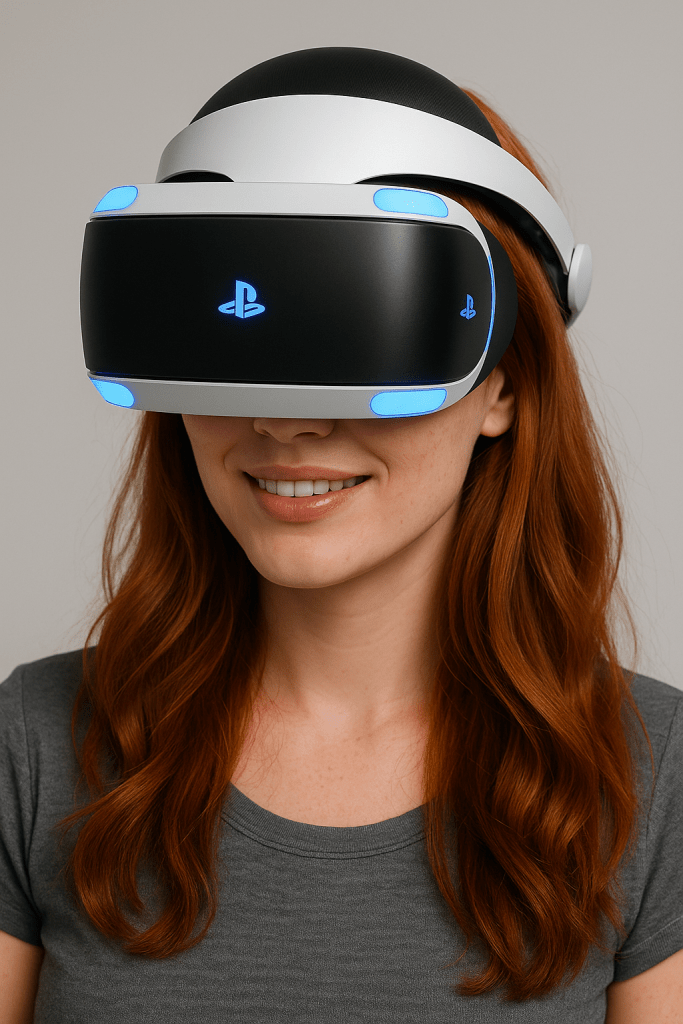
In 2012, Luckey launched Oculus VR to promote his Kickstarter campaign aimed at making his vision a reality. He showcased the Oculus Rift at major gaming conventions, attracting a significant following and catching the attention of Facebook CEO Mark Zuckerberg, who would buy Oculus in 2014 for $2 billion. In the same year, Sony PlayStation introduced Project Morpheus, their newest VR headset for the PS3.
And the race was officially on again! After Oculus became Meta, three VR headsets have since been released, leading the market today. Morpheus eventually morphed into PSVR2 by 2023, which is still holding tight. HTC launched the Vive Pro 3 in 2016, a favorite among critics. And lastly Apple joined the ranks with the release of its expensive Vision Pro in 2024, to somewhat mixed reviews, while given that VR is still relatively in its infancy, a clear winner hasn’t yet been crowned. (Kim, Jonathan. “Apple Vision Pro: I like This Strategy.”)
While some might argue that consumers are the real winners in the evolution of virtual reality, others contend that technology is creating the illusion of unity while distancing us from genuine social interactions. However, with endless possibilities for generating communities through one-on-one and multiplayer experiences, social VR platforms may just be creating more meaningful connections where none existed before. (Marr, Bernard. “Future Predictions of How Virtual Reality and Augmented Reality Will Reshape Our Lives.” Forbes, 4 June 2021)
Whatever your take on it, it doesn’t look like it’s letting up anytime soon. The future of VR is expected to reach new heights, featuring super-lightweight, crisp, ultra-realistic graphics. One product currently on the market, the $13,000 TESLASUIT, may one day be replaced by a neural implant—a permanent chip that will mimic a full-body haptic suit, allowing you to taste, feel, and even hear the simulated world around you without the inconvenience of wires tying you down. (Full Body Haptic VR Suit for Motion Capture and Training.” TESLASUIT, 2023)
Some start-up companies you might want to invest in, that are already on the path to the future, include Ekto VR, which has created robotic boots that provide the sensation of walking, matching your movement within the game. The Ekto One robotic boot’s resemble futuristic roller skates—except, instead of wheels, they have rotating discs on the bottom that move to match the direction of the wearer’s movements. Another company, Mojo Vision, has been developing AR custom micro-lens optic contact lenses with micro-LED displays that project information inside the wearer’s eyes, allowing them to see whatever they choose. (“Mojo Vision, the Micro-LED Company.” Mojo Vision)
Imagine taking a vacation to one of those high-priced exotic locations you’ve only dreamed of visiting. While you’re there, you can shed any physical insecurities and step into the skin of your very own personalized avatar. Much like navigating Google Maps, you could walk or drive around, shop from store to store, and even buy merchandise from local retailers via their online websites, all while experiencing tourist attractions from the safety of your home—or better yet, through the new startup company you purchased this virtual vacation from, tailored to make the experience even more real. The entire island of Bora Bora could now be yours to explore simply by purchasing the game from home or buying a ticket through a local VR travel agency.
While these ideas may mortify those who fear it could lead to social alienation—where only the elite can afford the luxury of real travel with added safety and privacy, leaving the lower class with the only option of virtual travel—it is also seen as a glimmer of hope for those with disabilities and those who experience public anxiety to be able to experience things within their comfort zone.
Will society become so immersed in the future of AI and VR that the future of our realities become dangerously subjective?
One question remains: will it be the red pill or the blue pill? The choice is yours to make.
Just a stone’s throw from the Washington-Idaho border, something vibrant has once again taken root at the newly-opened Vicki’s Garden Center — and it’s not just the flowers.
The freshly-launched garden center located in Liberty Lake, a second location for the decades-old Lima family greenhouse operation, marks a new chapter in a story that began generations ago and continues to grow, quite literally, from the ground up. The new garden center isn’t just a business expansion;it’s a tribute to a growing family legacy that spans back to the 1980s when Marian Lima and her husband Ed Lima ran the original operation from what is now the main office located in Latah Valley.
Nick Lima, son of Ed & Vicki Lima, is a third-generation family member who now helps manage the day-to-day operations.
“This house, this property, it was all part of my grandparents’ life,” Lima said. “They lived here, worked here. It’s been a family affair since the beginning.”
The transition from wholesale to a combination of wholesale and retail began when the family passed the torch in 2012. With aging greenhouses and a changing market, the Lima family saw an opportunity to imagine an even more colorful future.
“We decided to diversify,” Lima said. “We kept the wholesale side, but introduced more retail. That decision led us to repair the original greenhouses and evolve the space into something new.”
Today, Vicki’s Garden Center is known for helping make Spokane even more beautiful and is a patchwork of color and community. Alongside classic annuals and perennials, visitors find unique fruiting trees, succulents, and specialty roses — handpicked to stand out in a competitive market.
“We used to just stock the extras from wholesale in the garden center,” Nick said. “But now we order-in unique items specifically for the garden center. It’s about creating an experience.”
It’s a multigenerational ecosystem where everyone has a part to play. Parents own the operation, siblings work full-time, and even the retired grandparents still weigh in on major decisions.
“There’s nobody missing from the puzzle,” Nick said. “Everyone’s got an important role.We’ve had bad seasons, good seasons — it’s a learning curve. But I love it. There’s always something new to figure out.”
From mastering efficient crop management to navigating state regulations during the COVID-19 pandemic, the family has weathered many storms.
“COVID was tough. It squeezed us financially for years,” he said. “But we stayed above water. And now we’re finally finding our footing again.”
Lindsey Macavoy, the manager at the new location loves coming in everyday to such a beautiful sight.
“Our customers are always in the best mood,” she said. “Nobody shops for flowers in a bad mood.”
It’s only been a month since the grand opening but with steady foot traffic and local support the garden center will quickly become a go-to destination for locals seeking something colorful.
Beth Fields, a longtime customer, mentions that she used to commute all the way from Greenacres to the first location.
“It’s almost like a tradition to come and pick out Annuals for our garden,” she said “You can’t beat the prices, and the family is always around working hard. Now I feel spoiled with the new location being closer to home.”
Among their longstanding partnerships, none is more iconic than the Coeur d’Alene Resort’s red geraniums. For over 30 years, the Limas have supplied 30,000 to 40,000 of the signature blooms each year — a tradition stemming from a special Mother’s Day and a favorite color.
“That relationship started between my grandpa and Duane Hagadone in the ‘80s,” he said. “And it’s still going strong.”
Other long-standing clients include local golf courses, general stores, and independent hardware shops, many of whom have trusted the Limas for generations. Beyond sales, Vicki’s Garden Center has cultivated a sense of community through local events and educational offerings as well as appearances at the Spokane Colleges Home and Garden Expo, the team works to stay engaged and accessible. The family said their future vision is to grow the garden centers’ public presence and fine-tune its family operations. With quality as their cornerstone, the Limas are confident.
“The team keeps a close eye on our crops,” Lima said “We even shop at other stores to compare. Customers tell us our quality is the best in town — and that helps us stand out. We’re not just here to sell plants, we’re part of the community.”















 Janeseed